Research Programme
The Coherence Programme
"Strategy is what you say. Coherence is what actually happens."Providing diagnostic protocols and methods to detect strategic drift in layered governance systems.
Most institutions suffer from translation drift—the silent decay of intent as decisions move through the governance spine.We develop concepts and methods to observe, measure, and correct translation drift.Understanding how strategic intent becomes coordinated action—and how that translation changes as decisions propagate through governance systems.
A research programme studying how institutional decision systems learn, drift, and realign under conditions of complexity and delayed feedback.The programme treats the institutional decision system itself as the primary object of study: the structures, signals, and interpretive processes through which intent becomes action.This site serves as the canonical overview and reference point for the Coherence Programme and its associated publications.
Application & Collaboration
This research is being developed for application in institutional decision systems across domains including public policy, research funding, and complex organisational governance.It enables institutions to observe how strategic intent is translated into decision criteria, metrics, and actions—and to detect where coherence is preserved or lost before it becomes visible in outcomes.The programme is developed as an independent research initiative and is open to collaboration with researchers, institutions, and policy organisations interested in advancing the empirical study of coherence and translation dynamics.
Apply the Coherence Programme
This research is being developed for real institutional decision systems.
If you are working in governance, funding, or organisational strategy, these methods can be explored in practice.• Explore a coherence diagnostic
Use the framework to assess how strategic intent translates into decisions across your organisation.• Collaborate on a field study (ongoing or future work)
Engage in early-stage collaboration to study translation dynamics in real-world systems.• Apply the framework in your institution
Use the concepts and methods to strengthen alignment between strategy and execution.If this resonates with your work, feel free to get in touch.
Why this matters in practice
Institutional decision systems translate strategic intent into funding, priorities, and action.
When this translation drifts, outcomes diverge—often without being immediately visible.• For policymakers
Detect when policy intent is being reinterpreted as it moves through programmes, instruments, and evaluation criteria—before divergence becomes visible in outcomes.• For research funders
Ensure that funding decisions reflect strategic intent, rather than the constraints of evaluation systems, scoring rules, and comparable metrics.• For institutions
Maintain alignment between strategic priorities, operational decisions, and long-term outcomes across complex organisational structures.
Why Good Organisations Drift
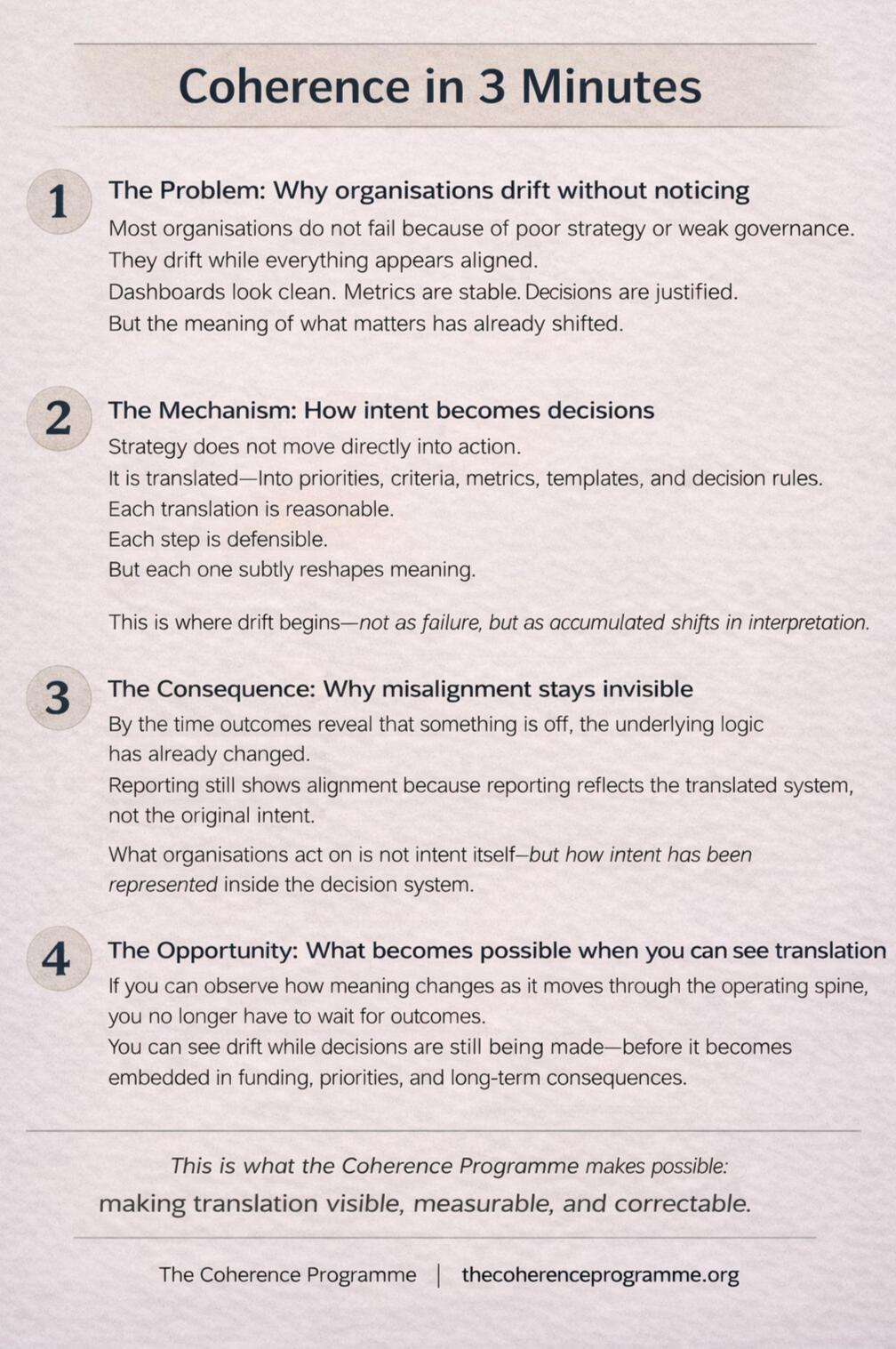
Most organisations do not fail because of poor strategy, weak governance, or bad decisions.
They drift while everything appears to be working.Not suddenly. Not visibly. But over time.A strategy is defined.
It is translated into priorities, into criteria, into metrics, into decisions.At each step, the meaning of what matters is slightly reshaped.
Each translation is reasonable. Each decision is defensible.And yet, something changes.What the organisation does gradually diverges from what it originally intended.
Not because people failed—but because the system that connects decisions quietly transformed the meaning along the way.It is difficult to see.Most organisations look at outcomes. But outcomes arrive late.
By the time results suggest something is off, the underlying logic has already shifted.In the meantime, everything appears coherent.
Dashboards look aligned. Metrics are stable. Decisions are justified.But it may already be moving in a different direction.
What organisations act on is not intent itself.
They act on how intent has been translated—into criteria, models, metrics, and decision rules.Those representations become the basis for decisions.
And over time, they take on a life of their own.
This is where drift begins.Not as failure. Not as misalignment in the obvious sense.
But as a gradual change in what decisions actually mean.
If this becomes visible, something changes.You no longer have to wait for outcomes to tell you that something is wrong.
You can see how direction is shifting while decisions are still being made.Before it becomes embedded in funding, priorities, and long-term outcomes.
The challenge is not defining strategy.
It is preserving coherence as strategy becomes action.
If this feels familiar, you are not alone.
This is not a failure of execution.
It is a structural property of how complex decision systems operate.The question is not whether drift exists.
The question is whether it becomes visible early enough to be guided.
Start Here
New to the programme?Start with the overview above, or explore from your perspective:
Translation Drift in Practice
A short illustration of how coherence is lost—and how it can be preserved
Organisations rarely lose coherence because of strategy. They lose it as strategy is translated into decisions.A leadership team defines
a clear strategy.
It is translated into goals.
Teams commit to
delivering outcomes.
Dashboards show progress.
Everything looks aligned.But alignment in reporting
is not alignment in reality.
Over time, something has shifted.Teams optimize for their own metrics.
Priorities are reinterpreted.
Local decisions begin to diverge.
Reporting still looks coherent—
but reality is not.This is drift. Drift is not random.
It is structured misalignment.Not because people fail—
but because the system that connects decisions, signals, and actions
is structurally fragile.
The challenge is not defining strategy.
It is preserving coherence as strategy moves through the organization.Coherence depends on the structure that connects decisions.
This is what we call the
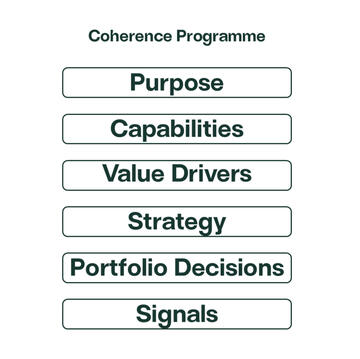
Operating spine:A connected chain that links decisions from what matters → to how it is translated → to how it is measured → to how it is acted upon → to how the system learns and realigns.When the spine is strong, coherence holds.
When the spine weakens, drift emerges—often invisibly.
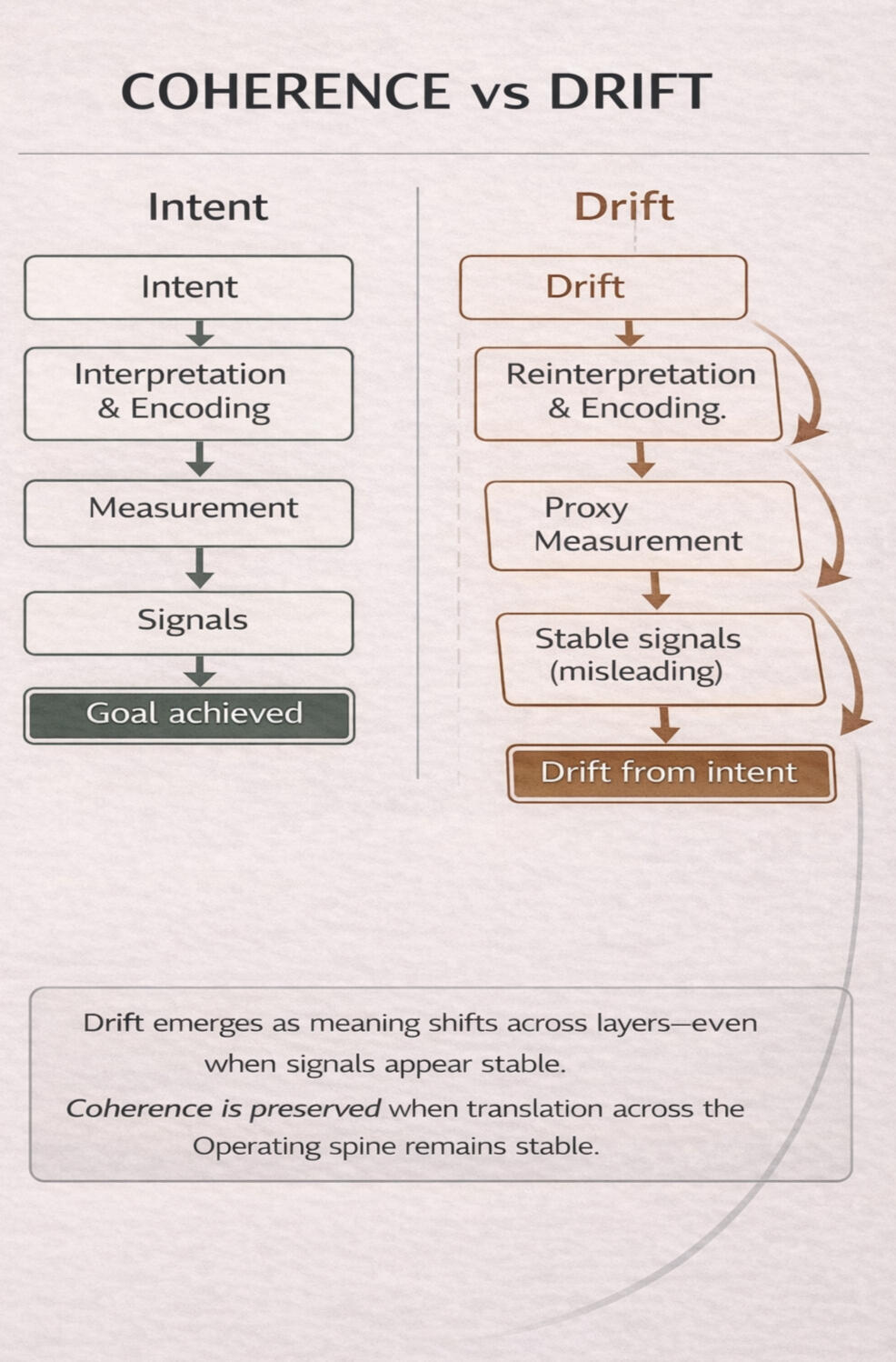
Coherence is preserved when translation across the Operating spine remains stable.
Drift emerges when meaning, measurement, and action gradually diverge.
This is not just a conceptual problem. It is directly observable in real institutional systems.
A Simple Example of Translation in Practice
This example shows how institutional intent is transformed as it becomes the basis for decision-making.The European Research Council states that funding is awarded based solely on excellence.This sounds straightforward. The best research should get funded.But when proposals are actually evaluated, excellence is not assessed as a concept.It is translated into specific questions, criteria, and scoring rules. Proposals are evaluated based on how well they perform against these elements, and funding is awarded by ranking.In practice, decisions are not made on excellence itself. They are made on the system used to represent it.The concept remains the same in name, but what is actually evaluated, compared, and funded is its translated form.The Coherence Gap: The ERC intends to fund “excellence.” In practice, it funds what can be ranked. This is how translation becomes drift across the decision spine.Source: What Gets Funded Depends on How Intent Is Translated
Shows how funding decisions operate on translated criteria rather than on intent itself.
A Simple Coherence Self-Diagnostic
These questions help you see whether your organisation is acting on its intent—or on translated versions of it.You don’t need data to answer them. If a question feels uncomfortable or hard to answer clearly, that is already a signal.These are not symptoms of failure. They are early signals of how meaning moves—and changes—inside your decision system.“Answering these questions quickly is not the goal. Not being able to answer them clearly is the signal.”
Can you point to where your strategic intent is explicitly encoded in the criteria that drive funding or prioritisation decisions? (If not, decisions are likely being made on implicit or substituted interpretations of intent.)
If two teams interpret your strategy differently, would the system detect it—or would both still appear aligned in the data? (Drift often begins when different interpretations produce similar-looking outputs.)
Do your metrics measure what actually matters—or what is easiest to measure and compare? (What is measurable gradually becomes what is optimised.)
When a decision is made, can you trace how it connects back to the original intent—or only to intermediate criteria and scores? (Most systems lose traceability as decisions move through layers.)
Have your evaluation criteria changed over time without an explicit re-evaluation of what they are meant to represent? (Small, rational adjustments accumulate into structural drift.)
Do dashboards and reports give you confidence—or do they sometimes feel “too clean” compared to what people experience on the ground? (Signals can remain stable while underlying reality has already diverged.)
Are teams optimizing for what the system rewards—even when that may not fully reflect the original intent? (Local optimisation is one of the main drivers of drift.)
How long would it take before a shift in interpretation becomes visible in your system? (In many systems, drift becomes visible only after it is already stabilised in decisions.)
Are the rules, models, or templates used in decision-making regularly examined for whether they still reflect what matters? (Governance systems run on artefacts—and artefacts carry meaning.)
Do you know where in your system meaning is most likely to change as decisions move from strategy to action? (Drift does not happen randomly—it occurs at specific translation points.)
If several of these questions are difficult to answer clearly, this is not unusual.It means you are operating under conditions where translation drift is likely—and not yet visible in your metrics or decisions.This is where indeterminacy lives.Our research provides the methods to make these gaps observable.
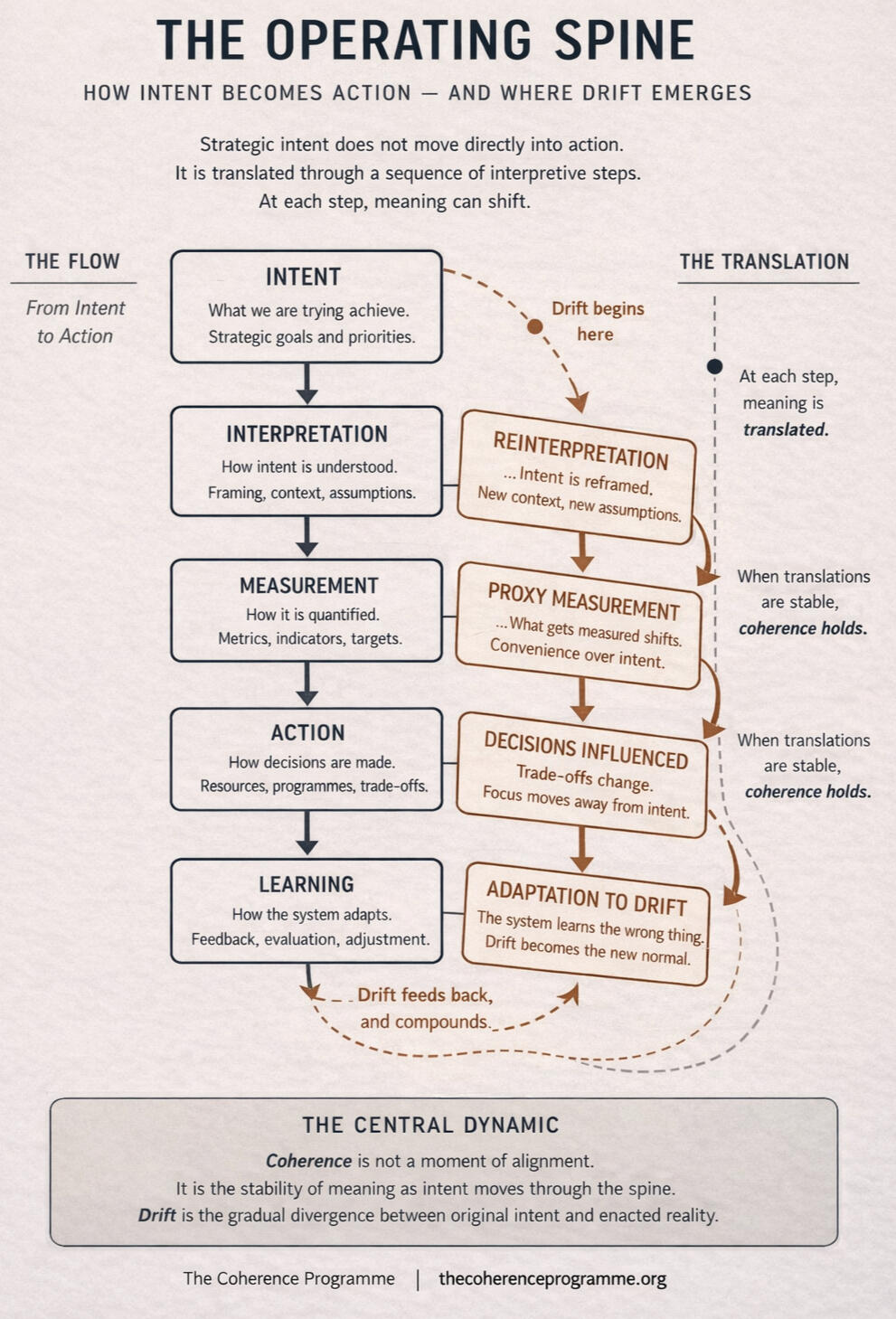
Note: This is a simplified representation. In practice, these transformations are recursive, context-dependent, and mediated by institutional artefacts.
How Coherence Breaks
The Alignment ParadoxAlignment is visible. Coherence is not.Traditional management focuses on alignment—the apparent agreement of teams with goals and metrics.But alignment is a lagging indicator. By the time a dashboard shows deviation, the underlying system has already shifted.Strategic intent has not been ignored—it has been translated into something else.The Operating SpineThe Coherence Programme maps the operating spine: the sequence of transformations through which intent becomes action.What matters
↓ How it is interpreted
↓ How it is measured
↓ How it is acted upon
↓ How the system learnsAt each step, meaning is translated.When these translations remain stable, coherence holds.
When they shift—even slightly—drift begins.The Coherence ProblemEven well-governed organisations gradually lose alignment between strategic intent, funding decisions, and operational execution.This is not primarily a failure of strategy or execution.
It is the result of accumulated shifts in how intent is translated as decisions propagate.The research programme investigates:• how these translation dynamics emerge
• how coherence and drift can be observed empirically
• how institutions learn to detect and correct drift before it becomes visible in outcomesInstitutional Decision SystemsOrganisations are conceptualised as institutional decision systems through which priorities, meaning, and resources propagate across governance layers.Strategic intent does not move directly into action.
It is carried through artefacts—strategy frameworks, funding decisions, prioritisation mechanisms, and operational execution.This chain determines whether intent remains interpretable and actionable as it moves through the organisation.The research focuses on how these systems can become observable, measurable, and capable of learning.Research FocusOur current work focuses on three interrelated problems:1. Translation Drift—The measurable decay of intent across institutional layers
2. Distributed Coherence—How systems maintain fidelity without rigid top-down control
3. Agentic Governance—The role of AI as a stabilizer—or disruptor—of institutional meaning
Research Questions
The programme explores a set of core research questions concerning institutional decision systems and governance learning:
Translation dynamics—How do organisations translate strategic intent into operational priorities through governance structures and decision signals?
Coherence and Drift—Why does alignment between strategy, funding decisions, and operational action gradually deteriorate even in well-governed organisations?
Observability—How can translation coherence within institutional decision systems be measured and observed empirically?
Early Detection—Can strategic drift be detected through governance signals before it becomes visible in performance outcomes?
Institutional Learning—Under what conditions do organisations learn to recognise and correct translation drift within their own decision systems?
Research Philosophy
The programme approaches institutional decision systems as scientifically tractable objects of study.Drawing on traditions in organisational learning, decision science, and sociotechnical systems research, the work develops conceptual architectures and measurement approaches that make governance processes empirically observable.The aim is not to prescribe organisational reform or replace human judgement with algorithms, but to improve the observability and learning capacity of institutional decision systems.
Programme Structure
The research programme is organised into three layers, each representing a distinct type of scientific contribution.
Conceptual Architecture—Formal specification of institutional decision-system structure, translation mechanisms, and boundary conditions. These papers define the scientific object of study and the causal mechanisms under investigation.
Measurement and Methods—Development of psychometric instruments, longitudinal measurement approaches, and analytical methods for observing translation coherence and decision-system learning over time.
Field Protocols and Empirical Studies—Field protocols and pilot studies designed to test whether increased observability of translation dynamics influences governance learning under real or simulated decision conditions.
The Coherence Map
A structured overview of the research programme across the decision spine
This table provides a complete overview of the research programme. Each paper links to its canonical version on Zenodo.Additional versions and working papers are available via other academic platforms (e.g. Research Gate, SSRN, Philpapers), also referenced in the Contact section.The research programme formalizes these dynamics across four layers of the decision spine: what matters, how it is interpreted, how it is measured, and how systems learn over time.
| Paper | Question | Insight | Output |
|---|---|---|---|
| Strategy—What Matters | |||
| The Coherence Framework: Explaining Institutional Drift through Translation | Why do institutions drift from their purpose even when they perform well? | Establishes institutional drift as a structural consequence of translation—showing that institutions act on decision-relevant representations rather than intent, such that coherence and divergence can emerge simultaneously. | Programme synthesis |
| The Coherence Programme: A Conceptual Overview and Entry Point to the Research Programme | What is the structure of the research programme? | Frames institutional coherence as a measurable system—linking strategy, decisions, and learning into a single observable spine. | Programme overview |
| The Sovereign Spine: A New Theory of Institutional Coherence and Agency | What is the underlying structure of institutional coherence? | Defines the structural architecture through which institutions translate intent into coordinated action over time. | Theoretical model |
| How Decision Systems Learn What Matters: Building Purpose-Aligned Governance | How is “what matters” defined and stabilized in governance systems? | Shows how institutions construct and stabilise “what matters” through governance artefacts and decision processes. | Governance model |
| The Margin of Purpose: How Institutions Lose What They Claim to Value | How does stated purpose erode in practice? | Explains how purpose gradually shifts as it is translated into operational decisions and institutional routines. | Conceptual analysis |
| Translation—How Meaning Is Interpreted | |||
| Designing the Meaning Infrastructure: Governing Interpretation in AI-Driven Institutions | How is meaning structured and governed across systems? | Introduces the concept of meaning infrastructure—how interpretation is shaped, stabilised, and distributed across systems. | Conceptual architecture |
| AI-Augmented Impact Frames: A Closed-Loop Architecture for Purpose-Aligned Decisions | How can intent be continuously re-aligned through AI-mediated feedback loops? | Shows how AI can be used to continuously realign decisions with intent through feedback across the decision spine. | Decision architecture |
| Translation Dynamics in Public Policy and Governance: A Replicable Method for Observing How Concepts Become Decision Criteria in EU Programmes (Recovery and Resilience Facility, Galileo, Erasmus+) | How do concepts become decision criteria in real systems? | Demonstrates how abstract policy intent is translated into concrete evaluation criteria in real institutional systems. | Empirical method |
| What Gets Funded Depends on How Intent Is Translated: Translation Dynamics in Funding Systems (ERC, Novo Nordisk Foundation, Gates Foundation) | How does institutional intent become the basis for allocation decisions? | Shows how funding decisions operate on translated criteria rather than on intent itself—creating systematic divergence over time. | Empirical demonstration |
| From Intent to Decision: Observing the Translation of Purpose in Institutional Decision Systems (Novo Nordisk, Eli Lilly, and Patagonia) | How does institutional purpose become actionable in decision-making? | Shows how purpose is translated into criteria, rules, and signals that shape what gets selected and scaled. | Empirical demonstration |
| The Translation Trap: When Strategic Intent Becomes Allocation Logic in European Governance (RRF, NZIA/CRMA, Horizon Europe) | How does institutional purpose become allocation logic in governance systems? | Demonstrates that funding and prioritisation operate on translated criteria rather than on intent itself. | Empirical demonstration |
| Why Systems Fail Before They Fail: The Double Translation Trap in the Boeing 737 MAX | How can a system remain internally coherent while acting in ways that contradict its purpose? | Explains the Double Translation Trap: a structural condition where a system starts measuring success by a proxy instead of its original purpose, creating an 'evaluative blind spot' that causes it to ignore real-world warning signs | Empirical demonstration |
| The Translation Trap: A Governance System for Strategic Drift and Institutional Alignment | How can institutions detect and correct strategic drift at the point of allocation? | Introduces a practical diagnostic that makes translation drift observable at the point of allocation—showing how systems come to optimise for metrics rather than intent and how this can be corrected before it becomes structurally embedded | Diagnostic method |
| Signals—What Is Measured | |||
| Making Meaning Measurable: How to See Coherence in Decision Systems | How can coherence be empirically observed? | Introduces measurement approaches that make translation coherence visible within institutional decision systems. | Measurement model |
| The Green Dashboard Trap: Why Institutions Lose Sight of Their Own Intent | How do metrics drift away from underlying intent? | Explains how metrics stabilise around proxies, creating the illusion of alignment while underlying intent diverges. | Diagnostic lens |
| The Field Protocol: Measuring Translation Coherence in Institutional Systems | How can translation coherence be measured in practice? | Provides a field-ready protocol for observing and measuring how meaning shifts across decision layers. | Experimental protocol |
| Detecting Strategic Drift Before Outcome Failure: A Longitudinal Governance Diagnostic | How can drift be detected before outcomes fail? | Shows how early signals in governance data can reveal drift before it becomes visible in outcomes. | Diagnostic tool |
| Decision Velocity and the Compression of Detectability: Translation Half-Life in Institutional Governance | How does speed affect the visibility of drift? | Explains how faster decision cycles reduce the system’s ability to detect and correct translation drift. | Analytical model |
| Learning & Drift—How Systems Change Over Time | |||
| The Coherence Problem: How Institutions Learn, Drift, and Realign | How do institutions drift and regain coherence over time? | Frames drift and realignment as part of a continuous learning process within institutional decision systems. | Conceptual framework |
| Why Strong Governance Still Drifts: How Institutions Quietly Lose Alignment | Why does drift persist even in well-governed systems? | Shows how small, locally rational decisions accumulate into systemic drift despite strong governance structures. | Failure analysis |
| The Coherence Advantage: Why Good Organizations Drift—and What Leaders See Too Late | Why is drift recognized too late by leadership? | Explains why drift remains invisible to leadership until it is already embedded in decisions and outcomes. | Insight framework |
| The Coherence Advantage: Why Good Organizations Drift—and How It Can Be Studied | How can drift be systematically studied? | Provides a research design for studying drift as a measurable and reproducible phenomenon. | Research design |
| The Sovereign Spine: How Institutions Stay True to Their Intent Over Time | How can institutions preserve coherence across time? | Outlines governance principles for maintaining alignment between intent, decisions, and long-term outcomes. | Governance principle |
| Reflection — Coherence, Meaning, and Institutional Purpose | |||
| Coherence through Drift: How Institutions Govern Representations Instead of Reality | How do institutions remain connected to the realities they were created to serve? | Explores how institutions gradually substitute representations for lived reality—and argues that coherence depends on maintaining reflective relation to purpose over time. | Reflective synthesis |
The programme is maintained as a living body of work, with ongoing updates and cross-platform dissemination.
Support the Programme
The Coherence Programme is an independent research initiative.If you find the work valuable, you can support its development and gain access to deeper analyses and ongoing research.
Or subscribe directly: Support the Coherence Programme
Programme Papers and Preprints
Selected papers from the Coherence ProgrammeIf you’re new to the programme, this is a good place to start. You don’t need to read everything—follow the reading path below to navigate the core ideas.
| Paper | Insight | Reading Path |
|---|---|---|
| The Coherence Programme | What the programme is about and how it fits together | Start here |
| The Sovereign Spine | How institutions decide what matters and act on it | Foundation |
| The Coherence Problem | Why organisations lose alignment over time | Why it matters |
| Why Strong Governance Still Drifts | How small decisions build up into drift | How drift happens |
| The Green Dashboard Trap | Why systems can look fine while going off track | Why it’s missed |
| Making Meaning Measurable | How to see and measure coherence | How to measure |
| Translation Dynamics in Public Policy | How ideas become decisions in real systems | In practice |
Programme Citation
When referencing the research programme as a whole, please cite the programme overview paper—Mertens, R. E. U. (2026). The Coherence Programme: A Conceptual Overview and Entry Point to the Research Programme. This paper provides the conceptual overview and serves as the primary entry point to the research programme.The programme is developed as a coherent body of work across conceptual, diagnostic, and empirical contributions. All papers link to their canonical Zenodo versions, including citation formats (APA, BibTeX, etc.).
Mertens, R. E. U. (2026). AI-Augmented Impact Frames: A Closed-Loop Architecture for Purpose-Aligned Decisions. https://doi.org/10.5281/zenodo.18668799
Mertens, R. E. U. (2026). The Green Dashboard Trap: Why Institutions Lose Sight of Their Own Intent. https://doi.org/10.5281/zenodo.18641907
Mertens, R. E. U. (2026). The Coherence Problem: How Institutions Learn, Drift, and Realign. https://doi.org/10.5281/zenodo.18505050
Mertens, R. E. U. (2026). How Decision Systems Learn What Matters: Building Purpose-Aligned Governance. https://doi.org/10.5281/zenodo.17964280
Mertens, R. E. U. (2026). Why Strong Governance Still Drifts: How Institutions Quietly Lose Alignment. https://doi.org/10.5281/zenodo.18471068
Mertens, R. E. U. (2026). Making Meaning Measurable: How to See Coherence in Decision Systems. https://doi.org/10.5281/zenodo.18486778
Mertens, R. E. U. (2026). Designing the Meaning Infrastructure: Governing Interpretation in AI-Driven Institutions. https://doi.org/10.5281/zenodo.18494690
Mertens, R. E. U. (2026). The Field Protocol: Measuring Translation Coherence in Institutional Systems. https://doi.org/10.5281/zenodo.18657810
Mertens, R. E. U. (2026). The Sovereign Spine: How Institutions Stay True to Their Intent Over Time. https://doi.org/10.5281/zenodo.18646691
Mertens, R. E. U. (2026). The Sovereign Spine: A New Theory of Institutional Coherence and Agency. https://doi.org/10.5281/zenodo.18649453
Mertens, R. E. U. (2026). The Coherence Advantage: Why Good Organizations Drift — and What Leaders See Too Late. https://doi.org/10.5281/zenodo.18722321
Mertens, R. E. U. (2026). Detecting Strategic Drift Before Outcome Failure: A Longitudinal Governance Diagnostic. https://doi.org/10.5281/zenodo.18758416
Mertens, R. E. U. (2026). Decision Velocity and the Compression of Detectability: Translation Half-Life in Institutional Governance. https://doi.org/10.5281/zenodo.18770887
Mertens, R. E. U. (2026). The Coherence Advantage: Why Good Organizations Drift — and How It Can Be Studied. https://doi.org/10.5281/zenodo.18773479
Mertens, R. E. U. (2026). The Margin of Purpose: How Institutions Lose What They Claim to Value. https://doi.org/10.5281/zenodo.18804408
Mertens, R. E. U. (2026). The Coherence Programme: A Conceptual Overview and Entry Point to the Research Programme. https://doi.org/10.5281/zenodo.18925810
Mertens, R. E. U. (2026). Translation Dynamics in Public Policy and Governance: A Replicable Method for Observing How Concepts Become Decision Criteria in European Programmes (Recovery and Resilience Facility, Galileo, Erasmus+). https://doi.org/10.5281/zenodo.19112215
Mertens, R. E. U. (2026). What Gets Funded Depends on How Intent Is Translated: Translation Dynamics in Funding Systems (ERC, Novo Nordisk Foundation, Gates Foundation). https://doi.org/10.5281/zenodo.19237869
Mertens, R. E. U. (2026). From Intent to Decision: Observing the Translation of Purpose in Institutional Decision Systems (Novo Nordisk, Eli Lilly, and Patagonia). https://doi.org/10.5281/zenodo.19388948
Mertens, R. E. U. (2026). The Translation Trap: When Strategic Intent Becomes Allocation Logic in European Governance (RRF, NZIA/CRMA, Horizon Europe). https://doi.org/10.5281/zenodo.19388948
Mertens, R. E. U. (2026). Why Systems Fail Before They Fail: The Double Translation Trap in the Boeing 737 MAX. https://doi.org/10.5281/zenodo.19665145
Mertens, R. E. U. (2026). The Coherence Framework: Explaining Institutional Drift through Translation. https://doi.org/10.5281/zenodo.19730520
Mertens, R. E. U. (2026). The Translation Trap: A Governance System for Strategic Drift and Institutional Alignment. https://doi.org/10.5281/zenodo.20036706
Mertens, R. E. U. (2026). Coherence through Drift: How Institutions Govern Representations Instead of Realityt. https://doi.org/10.5281/zenodo.20346169
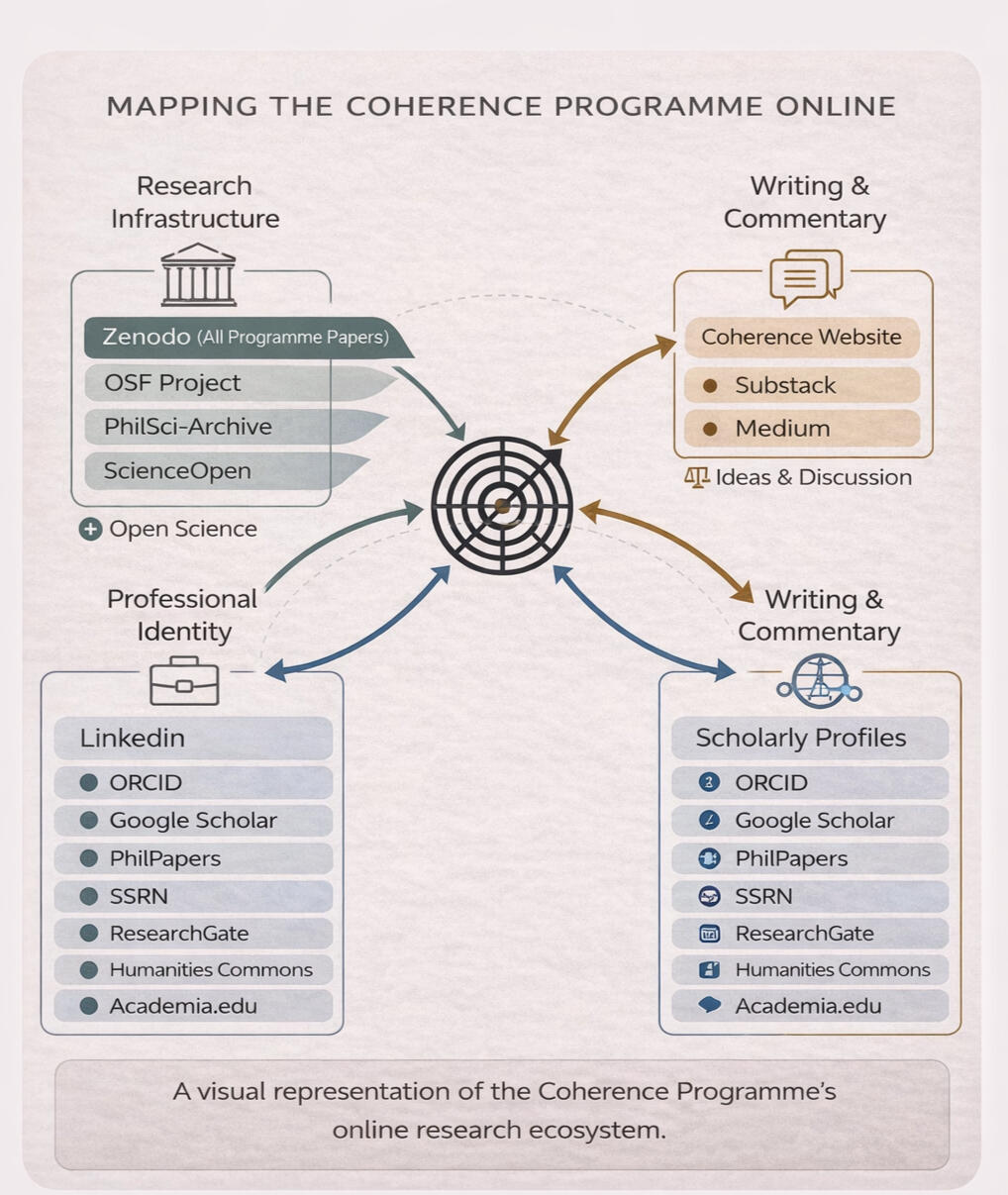
Supporting materials, figures, and methodological documentation are maintained through the programme’s open research infrastructure:• Coherence Programme Open Science Framework (OSF)—programme workspace and materials) repository
• Zenodo – The Coherence Programme Community with all Programme canonical paper versions and archival recordProgramme website: thecoherenceprogramme.orgThe Coherence Programme is developed as an independent research initiative and is open to collaboration with researchers, institutions, and policy organisations.
Research Materials
Supporting materials, figures, and working documentation are maintained through the programme workspace on The Coherence Programme Open Science Framework (OSF) Project.
conceptual architectures
methodological notes
field protocols
measurement instruments
visual models supporting interpretation and communication of the research
The OSF project functions as the programme hub and archival record for materials associated with the research programme.
About
The Coherence Programme is an independent research initiative investigating how institutional decision systems translate strategic intent into coordinated action, and how organisations learn to detect and correct strategic drift.The programme studies governance structures, decision signals, and translation processes through which priorities propagate across organisational layers. Its aim is to develop conceptual and empirical approaches that make these dynamics observable and scientifically tractable.The programme is developed by Robin Edgard Ulrik Mertens, a practitioner–researcher working on governance, institutional decision systems, and long-horizon value creation in complex organisations.The work draws on professional experience across life sciences, public institutions, and global technology environments, and seeks to contribute practitioner-informed perspectives to research on governance integrity, institutional learning, and responsible strategy execution.The programme operates as an open research effort, with papers, materials, and methodological artefacts shared through public research infrastructure.
Contact
Research infrastructure
Where the work is formally hosted and preserved as part of the programme.
Writing and commentary
Where ideas are explored, interpreted, and developed in a more open and discursive form.
Scholarly profiles
Where the work is indexed, attributed, and made discoverable across research networks.
Professional
Professional identity and broader context of work.